
Insights on Hospital-Acquired Infections in ICUs
Intensive Care Units are designed to save lives. But they also carry the highest risk of infection inside a hospital. Patients in ICUs often rely on ventilators, central lines, urinary catheters, and other life‑support devices. With their immune systems already compromised, this makes stringent infection control absolutely essential.
Public health bodies like the CDC, WHO, ICMR regularly publish data and prevention guidance on what are broadly known as healthcare-associated infections. Understanding those insights helps hospitals strengthen everyday safety practices.
Why ICU Cases Are at Advanced threat
According to CDC surveillance reports, the most common hospital-acquired infections in ICUs include:
- Central line – associated bloodstream infections
- Ventilator- associated events and pneumonias
- Catheter- associated urinary tract infections
- Surgical site infections
These infections are frequently linked to invasive devices. Each tube or catheter creates a potential pathway for bacteria to enter the body. The longer a device remains in place, the more advanced the threat.
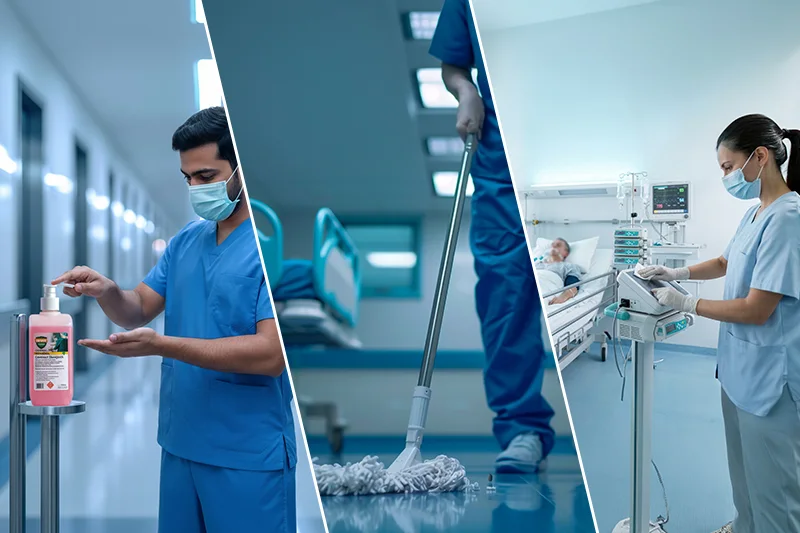
ICUs also involve frequent contact between healthcare workers, equipment, and patients. Without strict hand hygiene and thorough environmental cleaning, microorganisms can easily transfer from one surface to another, increasing the risk of infection.
What CDC Data Tells Us
CDC surveillance data shows that strong infection prevention programs can significantly reduce ICU infection rates. Key measures consistently highlighted include:
- Strict hand hygiene compliance
- Standardised device insertion and maintenance protocols
- Timely removal of unnecessary devices
- Routine environmental cleaning and disinfection
- Monitoring and reporting infection trends
The CDC emphasizes that environmental surfaces play a meaningful part in transmission. High-touch areas such as bed rails, monitors, IV pumps, call buttons, ventilator controls, and overbed tables require consistent and effective disinfection.
Even when surfaces appear clean, pathogens can survive for hours or days depending on the organism and conditions.
Environmental Disinfection in ICUs
Surface disinfection isn’t simply about appearance at the hospitals. It’s about reducing microbial load to intrude transmission.
In ICU settings, disinfectants must:
- Act against a broad range of microorganisms
- Work reliably even in the presence of some organic matter
- Be non-corrosive to sensitive equipment
- Allow quick turnaround of critical care spaces
- Be safe for routine and frequent use
Cororid Broad Spectrum Disinfectant 256 is formulated for surface disinfection through mopping, spraying, and fogging and linen disinfection. It contains QACs like DDAC and ADBAC as active ingredients and is effective against viruses, fungi, mycobacterium, and both gram-positive and gram-negative bacteria.
Key properties relevant to ICU environments include:
- Quick-acting formula
- Non-corrosive at recommended dosage
- Active across a wide pH range
- Aldehyde-free expression
- Non-flammable due to high water content
For fumigation reference, roughly 3 to 4 minutes is needed for an area of 15 square meters. Frequency of application depends on institutional protocols. In lower-risk premises, once daily may be sufficient, while ICU areas generally require more frequent cleaning as per hospital SOPs.
Ref:
CDC – Environmental Infection Control in Health-Care Facilities
Source:
https://www.cdc.gov/infectioncontrol/guidelines/environmental/
Relevant statement from CDC guidance:
“Cleaning schedules should be based on the risk level of the patient-care area and the degree of surface contamination. High-touch surfaces in patient-care areas require more frequent cleaning and disinfection.”
The objective is simple: reduce environmental contamination so that device care and hand hygiene efforts aren’t undermined by surface transmission.
Breaking the Chain of Infection in ICUs
The CDC’s approach to infection prevention is layered. No single step is enough. It’s the combination that protects cases.
- Clean hands before and after patient contact
- Follow sterile fashion for device placement
- Remove devices when no longer demanded
- Disinfect high-touch surfaces regularly
- Monitor infection rates and adjust practices
Environmental hygiene supports every other layer. When shells are disinfected consistently with an applicable broad-spectrum product, the risk of cross-transmission drops.
Why ICU Infection Prevention Is Ongoing Work
Infection control in ICUs isn’t a one-time activity. It requires:
- Staff training
- Audits and compliance checks
- Standard operating procedures
- Reliable disinfectant supply
- Data review and nonstop improvement
CDC guidance makes it clear that sustained adherence is what lowers infection rates over time. Short bursts of compliance don’t deliver long-term results.
Practical Takeaway for Healthcare installations
For hospitals administrators and infection control terms, the focus should remain on:
- Choosing disinfectants suited for critical care environments
- Ensuring correct dilution and contact time
- Increasing frequency in high-touch zones
- Documenting cleaning rounds
- Aligning environmental hygiene protocols with CDC recommendations
A broad-spectrum surface detergent such as Cororid BD 256 can support ICU cleaning programs when used according to institutional SOPs and label directions.
ICUs care for the most vulnerable patients. The stakes are high. CDC data shows that hospital-acquired infections can be reduced with disciplined, consistent prevention practices.
Hand hygiene, device care, and environmental disinfection must work together. When surfaces are properly disinfected, infection control becomes stronger at every level.
In critical care, prevention isn’t optional. It’s part of patient survival.
—
References
- Centers for Disease Control and Prevention (CDC).
Healthcare-Associated Infections (HAIs).
Overview of national surveillance data and prevention strategies.
https://www.cdc.gov/hai/ - CDC – National Healthcare Safety Network (NHSN).
Surveillance systems for tracking ICU-related infections such as CLABSI, CAUTI, and VAE.
https://www.cdc.gov/nhsn/ - CDC – Guidelines for Environmental Infection Control in Health-Care Facilities.
Evidence-based recommendations for cleaning and disinfection in hospitals and ICUs.
https://www.cdc.gov/infectioncontrol/guidelines/environmental/ - CDC – Core Infection Prevention and Control Practices for Safe Healthcare Delivery.
Practical guidance for preventing transmission in healthcare settings.
https://www.cdc.gov/infectioncontrol/guidelines/core-practices/ - CDC – Central Line-Associated Bloodstream Infection (CLABSI) Prevention.
https://www.cdc.gov/hai/bsi/ - CDC – Catheter-Associated Urinary Tract Infection (CAUTI) Prevention.
https://www.cdc.gov/hai/ca_uti/
CDC – Ventilator-Associated Events (VAE).
https://www.cdc.gov/nhsn/pdfs/pscmanual/10-vae_final.pdf