
What Patients Should Know About Infection Risks During Hospital Stays
Most of us think about our current illness when we go to a hospital. We hardly ever consider the germs that could be lurking on a call button or a bed rail or any other hospital environment. But those little dangers do exist. This guide aims to explain them in simple terms and demonstrate what you, your family, and the hospital staff can do when at hospital.
What is a hospital infection?
It is referred to as a hospital-acquired infection if you contract it while you are there or shortly after you return home. When a catheter is in place, it could appear as a urinary tract infection; when breathing aids are used, it may occur as a chest infection; or after surgery, it may appear as a wound infection. In addition to slowing recovery, HAIs may necessitate more testing, medication, and a longer hospital stay. As a result, hospitals work hard to maintain cleanliness, hand hygiene, and safe device care.
How do these infections spread?
There are different ways, will discuss one by one
Hands: Throughout the day, doctors and nurses interact with a lot of people and devices. If hands are not cleaned at the right times, germs can spread from one surface to another.
High-touch Surfaces: Remote controls, bed rails, tray tables, IV pumps, and door handles are all regularly touched. Germs may remain there in between cleaning cycles.
Tubes and Lines: Catheters, IV lines, and breathing tubes may be required in specific situations. Additionally, if care is neglected, they leave tiny gaps that let germs in.
Busy Spaces: Equipment is moved from one room to another in crowded areas. Workers change shifts. Individuals arrive and depart. All of this makes it more likely that bacteria or viruses will find new homes.
Instruments: Contaminated surgical instruments results in surgical site infectionSurface and Air: Contaminated surfaces and air also contribute to transmission of hospital acquired infections.
How hospitals reduce risk
Good hospitals apply multiple layers of protection rather than a single rule.
Hand Hygiene: Use of sanitizer, before and after touching a patient, after coming into contact with bodily fluids, and after touching the patient’s surroundings.
Skin antiseptics: Use of effective, faster, broad spectrum, skin antiseptics for skin prepping pre and post surgery.
Device checklist: When placing and maintaining lines, drains, and catheters, staff adhere to precise aseptic procedures and take them out as soon as they are no longer required.
Routine and final cleaning: While occupied, rooms are cleaned every day. Before the next patient comes in, the room is thoroughly cleaned after discharge.
Powerful disinfection of surfaces: Products are selected based on their broad action against common hospital bacteria, both gram-positive and gram-negative, as well as viruses, fungi, and mycobacteria.
An example of a surface disinfectant suitable for a hospital
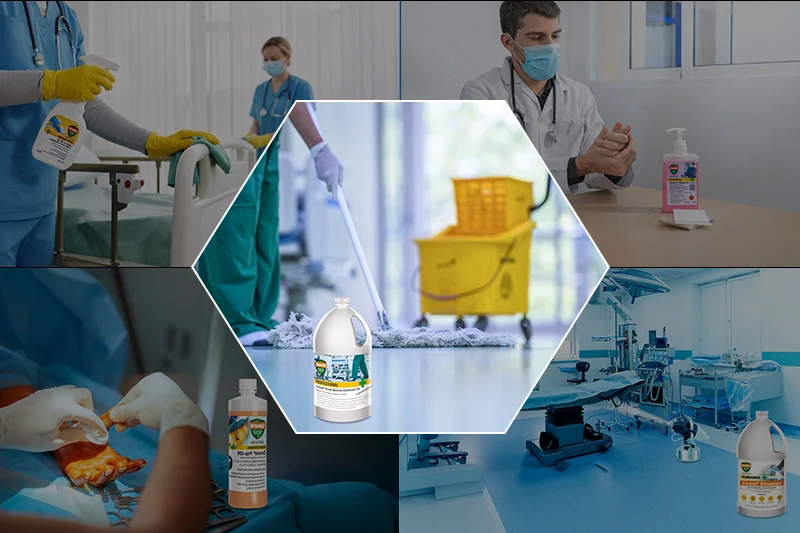
Hospitals, labs, airports, hotels, restaurants, and food facilities can all use Cororid Broad Spectrum Disinfectant 256 on their floors and surfaces. It can be used for fogging, spraying, and mopping by housekeeping teams and linen disinfection. The 5th Gen QAC, DDAC and ADBAC are its active ingredients. These are known to have broad germ control and are non-carcinogenic according to ECHA guidelines.
What this implies for families and patients:
- It is effective against a variety of pathogens including MDR. This also encompasses common hospital bacteria, mycobacteria, fungi, and viruses.
- Because it acts quickly, rooms can be put back into service quickly.
- It is non-corrosive at recommended dosages, and compatible with various surfaces protecting floors, metals, and coated surfaces.
- It still works over a wide pH range, even when there is a small amount of organic matter present. Also effective in hard waters and avoids scaling on surfaces.
- Its high water content makes it non-flammable, aldehyde-free, and suitable for daily use.
- Because it comes in 500 ml, 1 L, and 5 L packs, teams can match the pack to the task.
Hospitals determine how often to clean based on risk. One round a day might be necessary for a general office. More frequent attention is frequently required in a ward with vulnerable patients, particularly on high-touch points.
What a patient can do
You’re not just an observer. The care team benefits from small actions taken by you and your guests.
Ask: “Could you please clean your hands before you examine me?” is acceptable. The majority of employees value the reminder.
Be familiar with your gadgets: Find out how your line, drain, or catheter will be maintained and when it can be taken out. You are safer the sooner a device is not required.
Rub your hands frequently: Before eating, after someone has finished an exam, and after using the restroom, wash your hands. On the way in and out, visitors should wash their hands.
Don’t clutter the bedside table: Better cleaning results from less clutter. Keep wrappers and food off of surfaces used for procedures.
Report dust and spills: It is important to call out sticky areas, dust around vents, and moist areas. Housekeeping is curious.
Questions to pose to your care team
- What surfaces are cleaned and how frequently is my room cleaned during the day?
- What takes place in between patients to make room for the next one?
- Which disinfectants are safe to use close to pumps and monitors?
- What is the strategy for promptly removing a catheter or line if I have one?
- If I notice a spill or a missed spot, who should I call?
After discharge
Keep an eye on the surgical site or any area where a device has been placed. A fever, redness, swelling, warmth, pus, or an unpleasant smell should all be checked. Get in touch with your doctor or nurse if you notice any of these. Don’t delay. Keep follow-up appointments and take medications as prescribed.
Five reminders to keep in mind
- Hands should be cleaned upon arrival, before meals, and after using the restroom.
- Inquire about the removal and maintenance of the device.
- To clean, keep surfaces free.
- Remind guests to use hand sanitizer.
- Report spills or dusty vents immediately.
Why results depend on surface disinfection
With good reason, hand hygiene receives a lot of attention. Surfaces should be treated with the same due diligence. Numerous studies demonstrate that when cleaning is inadequate, patients who enter a room where a prior patient had certain infections are at increased risk. The solution is simple. Clean high-touch areas more than once a day in crowded areas, use a dependable product that covers a wide range of germs, follow the proper dilution, and give the contact time. Cororid Broad Spectrum Disinfectant 256 is one product that helps teams meet these steps without slowing down the day or damaging equipment. As a result, the next person who needs that bed will receive safer care and fewer germs will be left behind.
The takeaway
Every microbe cannot be eradicated by hospitals. They are able to reduce the odds. Families and patients can assist. The four basic pillars are safe device care, clean hands, effective skin antisepsis and trusted surface disinfection. Pose inquiries. Make use of the hand sanitizer by your bed. Keep your area neat. These seemingly insignificant behaviors safeguard healing days and the individuals who work alongside you.
Do you want the application guide that includes dilution charts and fogging timings for patient rooms and procedure areas? Request the Cororid 256 technical sheet or get in touch with our disinfection team.